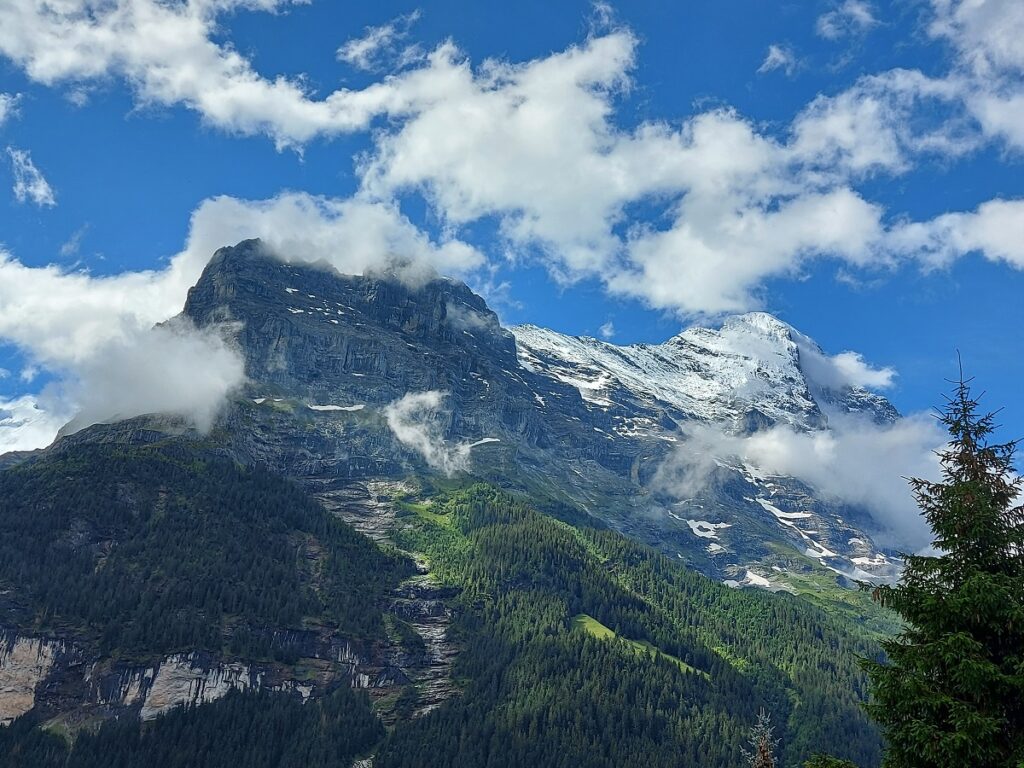
How do you follow-up on a almost perfect first ultramarathon experience? This question came up quickly after I finished the Eiger Ultra Trail E51 in 2019. I absolutely wanted to go back to Grindelwald running amongst these extraordinary mountains. Going up in distance to the E101 route was not really an option since I would have to have a few more solid years of training under my belt do even consider such a distance. However, signing up for the same distance again did not sound that appealing either. It is a big commitment to train for this distance and I was not sure how much I could improve within just one year. In 2019 we also had perfect weather and overall conditions, so chances were high, that a repeat would result in a worse experience. Thus, we opted for the E35 route, covering a distance of 35km with 2500m of ascent and descent, which on closer look is steeper than the 51km race with 3100m of ascent and descent.
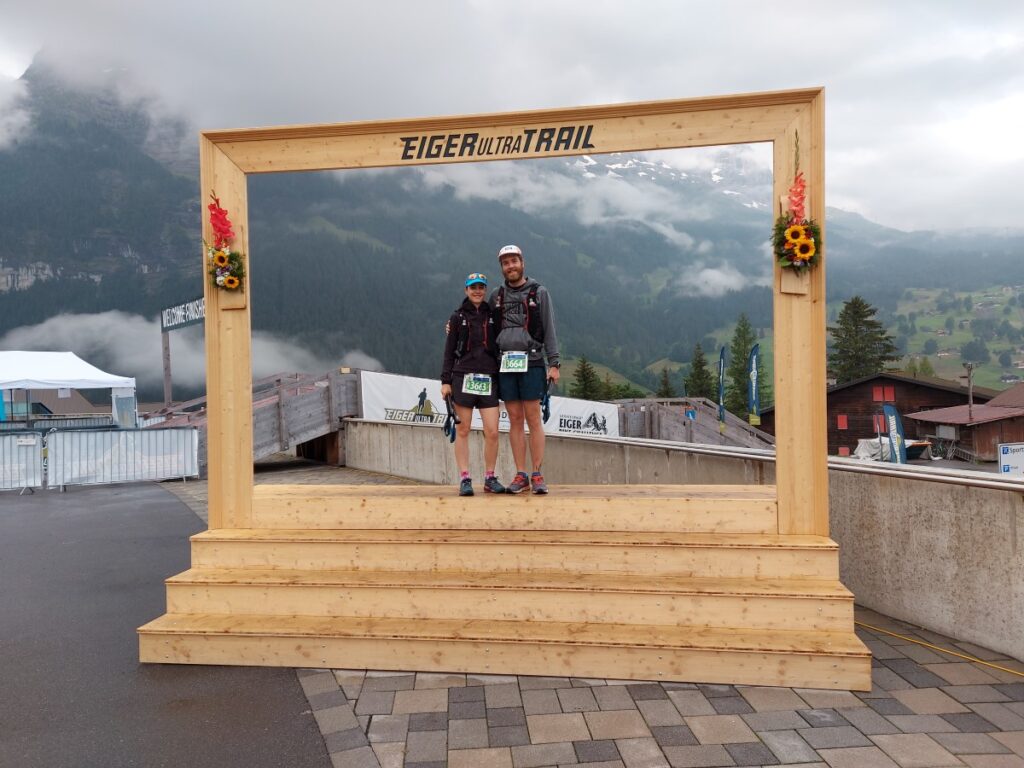
Course description – Eiger Ultra Trail E35
The E35 starts a bit outside of Grindelwald, in Burglauenen and first travels to Wengen. From Wengen you have a relentless climb up to Männlichen. During this extremely steep climb you are treated to an incredible view into the Lauterbrunnental and you can see the famous neighbours of the Eiger, the Jungfrau and the Mönch. Once you reached the top of the Männlichen you get on to some flowy trails towards the Kleine Scheidegg. If you have ever read a book about the Eiger north face and it’s momentous history, you have heard about the Kleine Scheidegg.
From the Kleine Scheidegg you follow a small single trail over some meadows, still enjoying the amazing view of the mountains. This single trail slowly starts to get a little bit steeper and very soon you realize, why some people consider this route much more brutal than the E51. Suddenly you stand at the bottom of this additional 1000m climb and you can see where you are going but the sheer steepness has you slowing down to an agonizing slog. The only redeeming factor of this part of the racecourse is, that once you finished this climb, most of what is to come is downhill. Also, if you have never seen a glacier from up close, you will be blown away by the view of the Eiger glacier. It is so close and looks so wild, almost worth it.
Once you made it up to the station called Eiger glacier you follow the Eiger trail which travels right underneath the Eiger north face. A very humbling and intimidating place to be. It is advisable though to not stare at the Eiger north face too much, because the trail is very technical, and it is quite easy to take a big tumble. After descending for a while, you will run by the famous station of Alpiglen, where people were sitting on the terrace of the restaurant enjoying their ice cream. That was the only moment in the race, when I considered dropping out for a second, because that ice cream looked too delicious.
Soon after Alpiglen is where the true grind will start. You’ve already past all the steep climbs and technical parts but you still have to bring it home. The last 6km of the race will take longer than you think, because there is a sneaky hidden clim near the Gletscherschlucht, which I could tell that it defeated a bunch of people around me. The last little bit back to Grindelwald is easy BUT just like with the E51 route there is this little section at the very end, which is only about 400m long, but it is the absolute steepest part of the course, just exquisite suffering till the end.
My experience
The race was fantastic, and I managed to push myself during the whole race which I was quite surprised by. I felt strong from the very beginning and found a good rhythm quickly. There was quite a bit of shuffling right after the start since the first bit of the course is on a small street. As soon as we got on to the single trail though I was in a good spot, and I could pace myself comfortably. During the first downhill towards Wengen all the nerves I had at the beginning of the race were gone, and I was just so excited to be there and to feel as strong as I did. From that point on I just went hard to see what is possible. Before the race we estimated that a realistic time to aim for would be somewhere between 6 and 7 hours. This was based on our experience from the E51 on similar terrain under the assumption that we had good weather conditions. And good weather conditions we had! Against all odds we had wonderful weather and the trails were in perfect conditions, even though we had one of the wettest summers I can remember and flooding across all of Switzerland during that time. So, in the end we managed to complete the race in 6 hours and 7 minutes, which I was and still am incredibly happy with.

Training leading up to the race
We originally planned to do this race in 2020, one year after the E51. However, since the whole year of 2020 was cancelled in all ways imaginable, the race was also postponed to 2021 early on. For me this was a blessing in disguise. After racing the E51 in the summer of 2019 it took me a while to get back into running consistently. Also, the 35km distance suddenly did not seem very daunting anymore, which is never a good mindset to train for a race.
After the race was officially postponed in early 2020, I did not get back in to running regularly until August 2020. I did a little bit of mountain biking and hiking, but I must admit that the lockdown life had a substantial impact on my activity level overall. Luckily, my interest in learning more about training and running was still there and that is where I put a lot of my energy and focus towards. Previously, my approach to training was very basic and primarily focused on building the necessary fitness to survive the ultramarathon distance. That approach worked reasonably well, and I achieved my goals. However, now I was curious about what I could achieve with a more structured approach. By “structured” I am not talking about a very intricate half marathon training plan with all these specific workouts. I am talking about bringing structure to the bigger picture, about implementing a periodization to the year. I did a base building phase in the fall of 2020 with much more volume than I ever did. Then I added some hill sprint workouts at the beginning of the year 2021 and subsequently added more race specific training (e.g., a lot of climbing) closer to the race.
I will go into more detail about my current training approach in a future post, but this is my conclusion so far: The fact, that I had a very solid base building phase did take out a lot of mental stress during later stages of the training phase. Something will always come up and you will have to adjust your training according to the new circumstances. Having a solid base to rely on really helps with the mental aspect of race preparation.
The other aspects of preparing for the race were much easier this second time around. I already knew how the aid stations will look like and the mandatory gear list is exactly the same as for the E51. Luckily I wrote a blog post about the gear I used for the E51, so I pretty much used the exact same things.

My conclusion
The Eiger Ultra Trail race series is already immensely popular across the globe and for good reason. The organization is very professional, the racecourses are challenging and tough and yet you get to run in some of the most beautiful mountains in Switzerland. Switching from the E51 to the E35 distance for my second race was a good decision, not only because I got to see a whole different area but also because it was challenging in a different way. Because the distance was less daunting, I was a little bit less in pure survival mode but wanted to see how fast I can cover this ground. Having said that, just yesterday I singed-up to run the E51 again in July 2022 and now I am curious how much faster and more efficient I can get. On to the next one!